Life & ideas
15 September 2024 · 5 min read By Nikesh Lagun
15 September 2024 · 5 min read
Ask Yourself: What Do I Need to Be Doing Right Now?
By Nikesh LagunBy Nikesh Lagun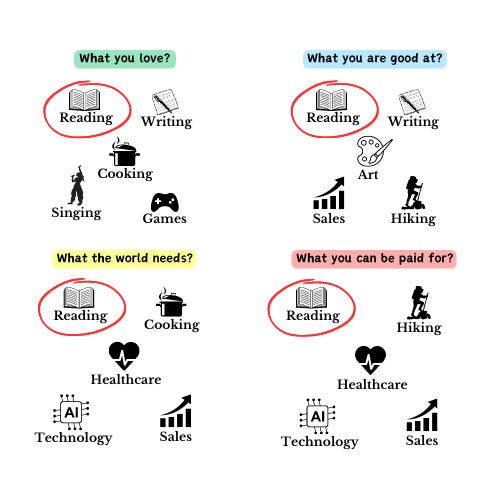
You probably know about Ikigai. Don’t you? Else, you might have heard it before. If it doesn’t ring a bell, don’t worry! I got you.
Ikigai is a Japanese term that means “the reason for being.”
It’s a book by Francesc Miralles and Hector Garcia that gives insights about longevity and finding purpose in life.
To live a young and fulfilling life, you need to utilize your natural resources.
Ikigai is believed to be a key to longevity and happiness among the centenarians of Okinawa. Finding one’s ikigai involves a deep, patient search, which is crucial for bringing satisfaction, joy, and meaning to life. On the other hand, the Japanese are not retirement-oriented like the cultures of developed countries such as the Western world, but rather engage in doing what they enjoy most.
To be fulfilled with life, eat an 80% full tummy, maintain strong social ties, and stick to the diet.
Let’s delve into the topic now.
What’s your sole purpose in life?
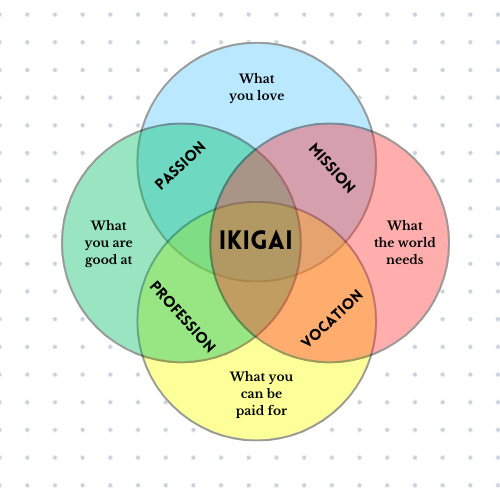
The core element of ikigai is the ikigai diagram, an illustration for examining the areas where four crucial components converge:
Your passion (what you love)
Your mission (what you should or like to do in life)
Your vocation (what can help the world and solve its problems)
Your profession (what you can be paid for).
Let’s play a short game.
Step 1: Begin by dividing a single sheet of paper into four sections. Label each section as “What You Love,” “What You Are Good At,” “What the World Needs,” and “What You Can Be Paid For.”
Step 2: Under the “What You Love” quadrant, capture all the activities that you are interested in. For example, it could be reading, writing, singing, dancing, gardening, cooking, gaming, or playing outdoor games.
Step 3: In the quadrant labeled “What You Are Good At,” identify the skills in which you excel. This could encompass reading, writing, cooking, driving, public speaking, or content creation.
Step 4: Proceed by listing in the third quadrant, “What the World Needs,” those activities or skills that address a current demand or contribute meaningfully to society. Then, in the final section, “What You Can Be Paid For,” note the tasks for which you can earn compensation.
Step 5: Identify any overlapping items across the quadrants and circle them.
These overlapping activities represent your ikigai. By aligning these factors, you can transform a side pursuit into a fulfilling career, one that provides satisfaction and aligns with your professional strengths, thereby minimizing the desire to leave a conventional 9-to-5 role.
It may seem somewhat challenging to try to identify the intersection of these four issues, but it is a quest that should begin somewhere. By pondering upon each of these aspects and envisioning the areas of intersectionality of your life’s pursuits, you are already on the right track to finding your ikigai and thus leading a happy and fulfilling life.
Finding the balance between these areas can feel tough, but it’s a journey similar to Morita’s therapy, which guides people to overcome struggles by uncovering the meaning in their lives.
Morita’s therapy is to help patients overcome their neuroses by finding their life’s meaning. It leads the patients to seek meaning in their lives, forcing the paralyzing sense of existential frustration to become a starting point for transformation. Patients get the motivation to surmount challenges through a process that involves identifying with a need for a fulfilling life, finding one’s calling, and accepting or rejecting that predestination.
It looks at the future and encompasses spiritual dimensions.
We don’t create the meaning of our life, as Sartre claimed—we discover it.
The basic principles of Morita’s therapy are:
Accept your feelings.
Do what you should be doing.
Discover your life’s purpose.
Try asking yourself these questions:
What do I need to be doing right now?
What action should I be taking?
And If you feel low, then
Accept the emotions without trying to control them.
Everyone gets distracted once or twice in the middle of either a conversation or study. It’s entirely normal to get distracted because a meditation master too finds their minds wandering during their practice. When you get distracted time and often, try this technique, which I learned from ‘The Charisma Myth.’
Try focusing on your breathing, the surrounding sounds, or the feelings in your toes as you close your eyes.
Our brain is programmed to pay attention to novel stimuli; they might be either sounds, sights, or smells. Whenever possible, try to focus on something as simple as your breath or your toes for a while to help you return to the present moment and continue on your task. Increasing your ability to be present not only improves your mental health and focus but also enhances your enjoyment of life.
Once you start getting absorbed in any activity, then you feel like you can go for more than usual. That’s because you entered a phenomenon called ‘flow’. It’s hard to achieve flow. You need to change your activities to enter the stage of flow.
Instead of working on monotonous tasks, try working as a game.
Increase the difficulty level of your task.
Use relevant pieces of music, like Lo-fi.
You can also use the Pomodoro technique; when you feel like things are getting exciting, pause the timer and stick to the task. Always separate your protected timeframe. That period should be for your task without any calls, notifications, or reels. If you can’t focus while having a phone, place it in the next room. Sometimes, adjusting your space also helps to alleviate distractions.
Sign up for the free Medium Newsletter. Connect on LinkedIn, Twitter, & Instagram.
Author and researcher. I write about why starting and staying focused are hard, and how to make them easier.
One research-backed idea a month, straight to your inbox.
Originally sent in the Lagunian Dispatch newsletter. View the original on Substack.