Cognitive Drive Architecture (CDA) is my proposed idea that "drive", your ability to start, keep going and finish, is not a fixed personality trait. It comes from how a few inner parts line up at any moment. When they do not, effort fails, even when you care. That is why willpower alone often does not work.
The three domains of Drive
Six variables sit in three groups. Together they decide if effort starts, holds and stays level.
flowchart LR
  subgraph IG["Ignition: does effort begin?"]
    P["Primode"]
    C["CAP"]
  end
  subgraph TE["Tension: does effort hold?"]
    F["Flexion"]
    A["Anchory"]
    G["Grain"]
  end
  subgraph FL["Flux: does it stay level?"]
    S["Slip"]
  end
  IG --> TE --> FL --> D["Drive: effort that starts, holds and finishes"]
  classDef out fill:#40734D,stroke:#2f5238,color:#fff
  class D out
Introduction
Cognitive Drive Architecture (CDA) is a proposed structural field within cognitive psychology that models Drive, the system's capacity to initiate, sustain, and regulate cognitive effort, as an emergent property of real-time system configuration, rather than a fixed motivational state or behavioral trait.
Why does effort sometimes fail to begin or collapse mid-task even when intention, knowledge, and motivation are in place?
It formalizes this question structurally, defining the internal conditions under which Drive is mechanically possible, and conversely, when effort failure must occur, regardless of desire or capacity.
Core Concept
Existing models in motivation, executive function, and attention describe correlates of effort, but not its structural architecture.
CDA asserts that Drive is not reactive, nor emergent from abstract states.
It is structural:
- Generated by the alignment of six internal system variables
- Governed across three operational domains
- Predictive of specific failure patterns and performance variability
The Architecture of Drive
At the heart of CDA is Lagunian Dynamics, a first-principles theory of Drive formalized through Lagun's Law of Primode and Flexion Dynamics.
Domains of Effort:
Ignition
Governs initiation of action (Primode, CAP).
Tension
Governs sustained engagement and attentional stability (Flexion, Anchory, Grain).
Flux
Governs intra-individual variability over time (Slip).
governs initiation of action
governs sustained engagement and attentional stability
governs intra-individual variability over time
Core System Variables:
Primode
The threshold readiness state determines if Drive can ignite.
CAP
Volitional energy modulating Primode; higher CAP → higher ignition probability.
Flexion
Structural elasticity, or how well the task "fits" the current cognitive state; high Flexion enables sustained engagement.
Anchory
Strength of attentional tethering stabilizes focus during performance.
Grain
Internal friction and resistance: higher Grain increases cognitive effort cost.
Slip
Controlled variability allows adaptive adjustment but introduces performance noise.
The Drive Equation
CDA formally models Drive with a computable equation:
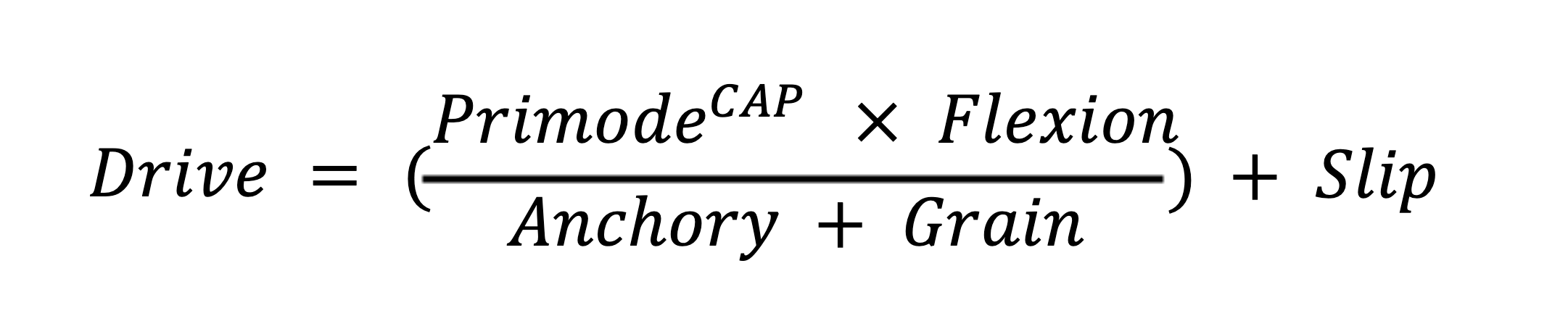
This architecture explains not just if Drive emerges, but precisely how,when, and why it collapses under specific conditions.
Failure Patterns (Configuration States)
Start Failure
No ignition despite intention.
Motivated Stall
Volitional tension without action.
Load Collapse
Early burnout or dropout.
Anchor Fatigue
Attentional drift mid-task.
False Focus
Persistent but non-productive focus.
Volatility
Inconsistent performance across time.
Inverted Ignition
Paralysis under pressure.
CDA uniquely classifies effort breakdowns as distinct structural misalignments, not as motivational deficits:
Toward a Structural Science of Effort
CDA's central claim is that effort is not a trait.
It is a system output, mathematically legible and structurally testable.
As a field, CDA seeks to advance:
- Precision modeling of effort variability
- Cross-domain understanding of performance failure
- Practical tools for optimizing Drive across contexts
This is a first-principles architecture, not a motivational toolkit. It models what must align internally for effort to begin, persist, or fail.
Explore Lagunian Dynamics → View Publications