Lagunian Dynamics is the model behind my work. It uses six simple parts, such as how ready you are to start, how well you hold focus, and how much inner friction you have, to explain when effort begins, holds, or breaks. Below is the full detail for anyone who wants it.
Primode: how ready you are to start. CAP: your push of willpower. Flexion: how well the task fits you right now. Anchory: how well you can hold your focus. Grain: inner friction and resistance. Slip: day-to-day wobble.
Lagun's Law at a glance
The equation drawn as a flow.
flowchart LR
  P["Primode
readiness to start"] --> TOP["Push to start
Primode to the power of CAP, times Flexion"]
  C["CAP
push of willpower"] --> TOP
  F["Flexion
fit with the task"] --> TOP
  A["Anchory
focus grip"] --> BOT["Resistance
Anchory plus Grain"]
  G["Grain
inner friction"] --> BOT
  TOP --> DIV{{"push divided by resistance"}}
  BOT --> DIV
  DIV --> ADD(("plus Slip
wobble"))
  ADD --> D["Drive"]
  classDef out fill:#40734D,stroke:#2f5238,color:#fff
  class D out
The seven failure patterns
Which combinations of the six variables lead to which kind of stuckness.
flowchart LR
  c1["Low Primode"] --> p1["Start failure
no ignition despite intention"]
  c2["High CAP, inactive Primode"] --> p2["Motivated stall
tension without action"]
  c3["Low Flexion, high Grain"] --> p3["Load collapse
early burnout or dropout"]
  c4["Low Anchory, high Grain"] --> p4["Anchor fatigue
attention drifts mid-task"]
  c5["High Anchory, low Flexion"] --> p5["False focus
persistent but not productive"]
  c6["High Slip"] --> p6["Volatility
inconsistent performance"]
  c7["High CAP, Primode at zero"] --> p7["Inverted ignition
paralysis under pressure"]
  classDef c fill:#e9e4f4,stroke:#B7A7D9
  classDef p fill:#f8e9db,stroke:#D98B48
  class c1,c2,c3,c4,c5,c6,c7 c
  class p1,p2,p3,p4,p5,p6,p7 p
Introduction
Lagunian Dynamics is the foundational theory of Cognitive Drive Architecture (CDA).
It provides a first-principles model of Drive, explaining how cognitive effort emerges as a structural output of interacting system variables.
Where CDA defines the field, Lagunian Dynamics defines the mechanics:
- The precise variables
- The equations governing Drive
- The dynamic patterns of effort failure, and success
Conceptual Foundation
Problem Addressed:
Cognitive psychology lacks a rigorous structural model explaining:
- → When Drive will arise
- → Why Drive collapses despite high motivation or intention
Lagunian Dynamics asserts:
- Drive is a configurational state, not a fixed trait
- Effort failure can be formally modeled, not treated as random or mysterious
- System variables interact non-linearly, producing distinct performance dynamics
The Law of Primode and Flexion Dynamics
(Lagun's Law)
At the core of Lagunian Dynamics is a simple proposition:
Drive is structurally possible when Primode surpasses its ignition threshold under modulated CAP, and Flexion remains sufficient to stabilize attention across system resistance.
In formula:
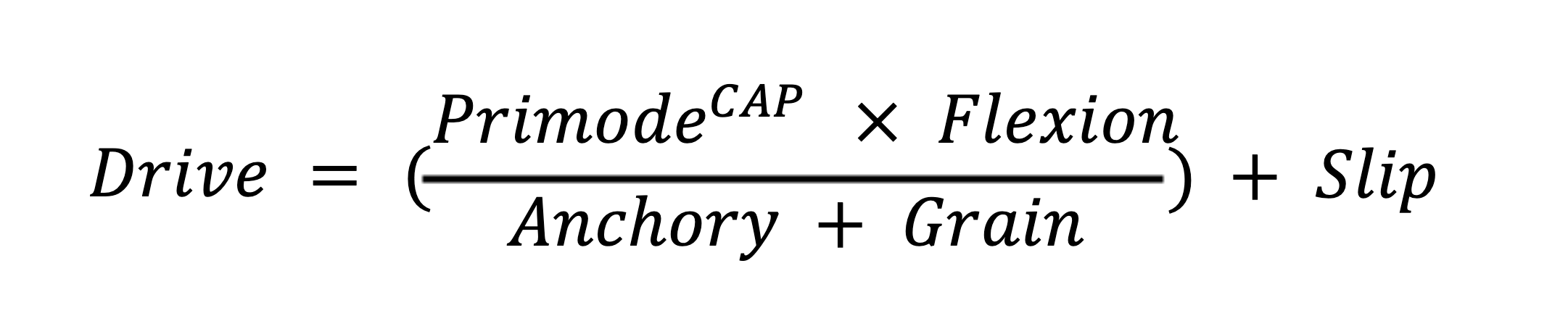
This equation predicts:
- When Drive will initiate
- How Drive will be sustained
- Where and why Drive will fail
The Six Core Variables
Primode
The threshold readiness state determines if Drive can ignite.
CAP
Volitional energy modulating Primode; higher CAP → higher ignition probability.
Flexion
Structural elasticity, or how well the task "fits" the current cognitive state; high Flexion enables sustained engagement.
Anchory
Strength of attentional tethering stabilizes focus during performance.
Grain
Internal friction and resistance: higher Grain increases cognitive effort cost.
Slip
Controlled variability allows adaptive adjustment but introduces performance noise.
Three Domains of Drive
Ignition
Whether Drive begins (Primode, CAP).
Tension
How Drive is sustained (Flexion, Anchory, Grain).
Flux
Moment-to-moment variability in performance (Slip).
Structural Failure Patterns
Start Failure
No ignition despite intention.
Motivated Stall
Volitional tension without action.
Load Collapse
Early burnout or dropout.
Anchor Fatigue
Attentional drift mid-task.
False Focus
Persistent but non-productive focus.
Volatility
Inconsistent performance across time.
Inverted Ignition
Paralysis under pressure.
Drive failure is not random, it corresponds to specific misalignments of variables.
Implications
Lagunian Dynamics enables:
- Prediction of when and why Drive will collapse
- Engineering of cognitive environments to optimize Drive
- Structural interventions to prevent burnout and attentional failure
- Cross-domain modeling of effort across learning, productivity, clinical, and performance settings