Life & ideas
28 July 2024 · 11 min read By Nikesh Lagun
28 July 2024 · 11 min read
IKIGAI: Reason for Being
By Nikesh LagunThe Japanese Secret to a Long and Happy Life
By Nikesh LagunThe Japanese Secret to a Long and Happy Life
Ikigai is a Japanese term that means “the happiness of always being busy”; this may positively influence the Longevity of Japanese people, especially those in Okinawa. The authors pay attention to Ogimi village — where the record of life expectancy was constantly increasing — to discover the facts of Okinawans' longevity. Along with natural resources and proper nutrition, they believed that the element of happiness — ikigai — helps the people of Ogimi live long and fulfilling lives. The book aims to share these principles and assist readers find their own ikigai for a long and happy life.
The art of staying young while growing old
Among the centenarians of Okinawa, ikigai — “the reason for being,” is believed to be a key to longevity and happiness. Finding one's ikigai involves a deep, patient search, which is crucial for bringing satisfaction, happiness, and meaning to life. The Japanese on the other hand are not retirement-oriented like the cultures of developed countries such as the Western world but rather engage in doing what they enjoy most. Studying Blue zones and people’s longevity — in Okinawa, for example — reveals the value of having a purpose, belonging, and reasonable standards of living. For instance, some of the practices that the Okinawan culture entails are eating to 80% full and maintaining strong ties within the social networks with the help of moais. They also have these elements in their diet besides health and long life span being attributed to the diet that comprises many veggies and tofu. Thus, the book aims to explore these notions and provide tips on how to choose and accept the concept of ikigai to achieve longevity and happiness.
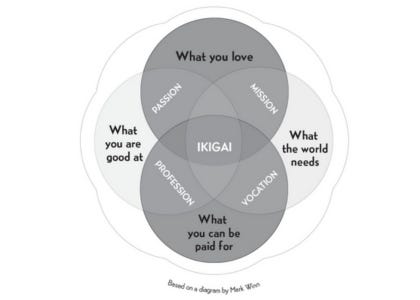
The core element of ikigai is the ikigai diagram, an illustration for examining the areas where four crucial components converge:
Your passion (what you love)
Your mission (what you should or like to do in life)
Your vocation (what can help the world and solve its problems)
Your profession (what you can be paid for).
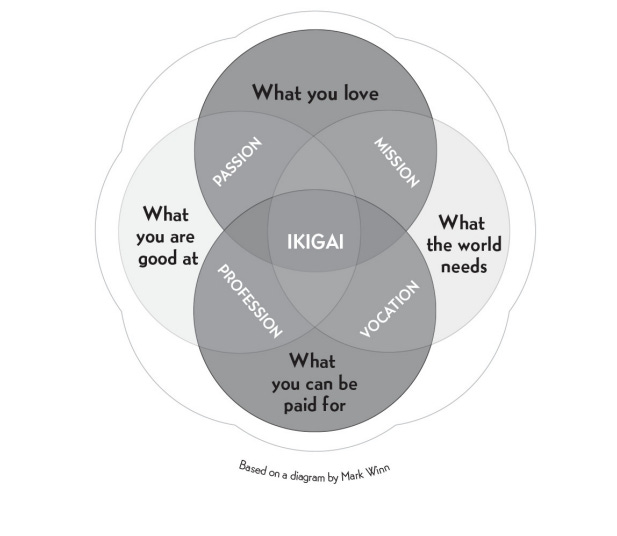
It may seem somewhat challenging to try to identify the intersection of these four issues, but it is a quest that should begin somewhere. By pondering upon each of these aspects, and envisioning the areas of intersectionality of your life’s pursuits, you are already on the right track to finding your ikigai and thus leading a happy and fulfilling life.
Little things that add up to a long and happy life
“Aging’s escape velocity” is the idea that if we could gain an additional year of life expectancy for every year of living, then it shall be known as biological immortality. This idea, which is like a rabbit pulling away from a man who constantly tries to chase it, is built on the foundation of advanced technology in the health sector. Some people such as Ray Kurzweil and Aubrey de Grey have optimistically expected to achieve this goal within several decades, while others believe that such range is limited by biology. Mentally stimulating exercises, a healthy lifestyle, and the absence of stress are some of the things that contribute to a long life. Stress is often said to be a negative aspect of life, but in moderation, stress is useful, as it helps people stick to a healthy regimen. Either lack of physical activity or sleep emphasizes aging, while the correct level of movement and sleep can maintain youth. Finally, a positive outlook and genuine awareness of one’s own emotions lead to a longer, happier life.
How to live longer and better by finding your purpose
The goal of logotherapy, which was created by Viktor Frankl, is to help patients overcome their neuroses by finding their life's meaning. While psychoanalysis relies on interpreting subjective experiences, and the realm of the unconscious, logotherapy leads the patients to seek meaning in their lives, forcing the paralyzing sense of existential frustration to become a starting point for transformation. Patients get the motivation to surmount challenges through a process that involves identifying with a need for a fulfilling life, finding one’s calling, and accepting or rejecting that predestination. Frankl affirms the trauma in Auschwitz but declares that to choose one’s attitude in any given situation is the only freedom mankind has. Logotherapy directs the healing process to humor, but it differs from psychoanalysis in that it does not dwell on past conflicts or self-pleasure-related urges and desires. Instead, it looks at the future and encompasses spiritual dimensions.
How to turn work and free time into spaces for growth
Psychologist Mihaly Csikszentmihalyi illustrates the phenomenon called “flow,” as the feeling of complete absorption in an activity. It emphasizes the need to find flow in activities with optimal levels of challenge and clear objectives that do not require distractions. To achieve flow, Owen Schaffer suggests seven conditions: the knowledge of activities to be done, the way of doing them, places to visit, perception of important threats and opportunities, and absence of interference. Thus, the flow-promoting strategies that can be used include choosing tasks that are slightly complex but doable, establishing goals, and focusing on one activity only to avoid the negative impacts of multitasking. The passage also introduces the deleterious effects of multitasking on effectiveness and stress levels and gives recommendations on how to optimize the surroundings to enhance one’s capacity to work and enter into a state of flow. This includes curtailing screen time, setting work hours, and being mindful. The flow in Japan is illustrated by such representatives as Takumi, engineers, and artists who find their ikigai or purpose in their work and enhance happiness and productiveness in critical and trivial tasks. Meditation and Ritual are also included in the manner of how Flow and finding Ikigai is possible, stressing the fact that happiness and meaning come from the journey instead of the destination.
Words of wisdom from the longest-living people in the world
Here, the authors focus on the strategy of healthy longevity being used by supercentenarians, or people who have reached the age of 110 or above. They take a look at the lifestyles and beliefs of such an individual and their centenarian years: Misao Okawa, the sushi-eating centenarian who credited her good life to eating sushi, sleeping well, and being full of energy; María Capovilla who lived for 116 years, anchoring her longevity to a vegetarian diet; and Jeanne Calment who credited her long age to a positive attitude to life accompanied by a vigorous They also stress the value of a proper life; arguing this referring to artists and scholars who maintain their activities in their advanced years. The book also focuses on the Japanese culture and how it promotes longevity, proving that along with health practices, the presence of a purpose, as well as being engaged in one’s community, one can live longer than expected.
Traditions and proverbs for happiness and longevity
To get to Ogimi, the authors had to travel three hours from Tokyo to Naha, Okinawa, before proceeding further to the so-called Village of Longevity – home of the world’s oldest people. Subsequently, after consultation with the town council, they took living accommodations and spent seven days engaged in conversation with the oldest adults of this population. Stretched from a lush jungle and a serene coastline, Ogimi has a touch of the old and slow pace of life. The town does not have a clear center which plies it in a fragmented appearance, but its community life is very active. End-users, even those in their nineties and over, engage in social activity such as playing gate ball and attending festivals, thus the communal way of life and celebrations are honored. Religion turns out to be important; the subjects’ beliefs in Ryukyu Shinto and memorial services, are reflected in the subject's daily activities. This led to finding out that while in Ogimi people attributed their longevity to a combination of good practices, social networking, and an optimistic and relaxed pace in life. The villagers are actively involved in purposeful activities, they respect nature, and are very sociable, which are some reasons attributed to their excellent health and long life spans.
What the world’s longest-living people eat and drink
Japan looks forward to having a life expectancy of eighty-five years for men and eighty-seven years for women, making it the highest in the world. Virtually 3 years for women, still, Okinawa, a Japanese province, stands higher than this national average.
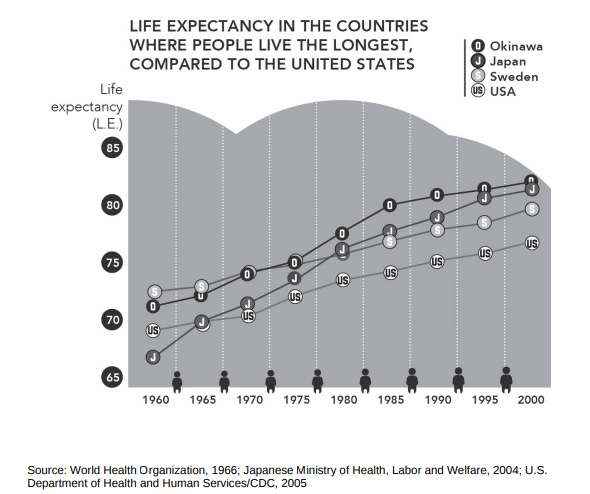
However, Okinawans experienced and suffered through and after World War II; they are now among the longest-living Japanese citizens. People from Okinawa are physically active, and their diet is free of surplus salt and sugar, and full of vegetables and grains. They occasionally eat fish and pork. The diet encouraged here incorporates the following; adequate food selection according to the ‘Hara Hachi Bu’ meaning that one stops eating when he or she is 80% full, and intake of antioxidants such as tofu, miso, and bitter melon. Also, Okinawans also have Sanpin-cha, which is a compound of green tea and jasmine, they consume it often, and helps to lower cholesterol and stress. Their diet also includes the intake of shikuwasa, which is a vitamin C-rich fruit that also has anti-oxidant properties. These entailing dietary practices in combination with the non-caloric restriction and high nutritive density make them live long.
Exercises from the East that promote health and longevity
Further, investigations in Blue Zones indicate that people here did not die from heart diseases, and this was due to a lack of intensive exercise but moderate activity throughout the lifespan. Hence, the elderly of Ogimi, The Village of Longevity, engage in exercises in their daily activities such as walking, gardening, and others without necessarily paying a lot of attention to exercise. This means that extended sitting is hazardous, as it slows metabolism and decreases the level of the above-mentioned cholesterol. Yoga, tai chi, and Qigong, the recent practices are origin from eastern, involve gentle and sustained physical activity besides being mindfulness. Yoga is an Indian discipline founded to develop various styles of exercise for mental and physical balance; also, Tai Chi and Qigong were discovered in China that provide effects such as improved balance, blood flow, and decreased stress. Moreover, methods such as radio taiso, a Japanese morning exercise, show the importance of routine light exercise. In sum, undertaking movement and conscious breathing in one’s daily schedule can affect longevity positively and promote the well-being of every individual.
How to face life’s challenges without letting stress and worry age you
Perseverance is the capacity to endure adversity or reverse and keep on working toward the advancement of desired purposes. It is also a core human virtue, referring to the act of standing firm in what constitutes the worth and the sense of life. It entails what is important and excluding what is irrelevant, especially emotions that are counterproductive to task performance. Stoicism and Buddhism have similar ideas on how to gain emotional strength and become immune to various negative feelings and emotions, to exist in the current state, and not strive for any desires. Stoicism says that one has to understand what is under our control and negative visualization, which means that when it comes to loss, one has to be ready for it. Likewise, Buddhism promotes mindfulness in the regulation of emotions as well as regulating thought through meditation. Another two concepts of the traditional Japanese culture that help to understand the value of embracing imperfection and the transitory nature of existence are wabi-sabi and ichi-go ichi-e. Leaving aside resistance, the concept of antifragility offered by Nassim Nicholas Taleb defines the objects that not only survive the shocks but also become stronger and more efficient. Due to those shocks and those proposing that redundancies are useful, taking small risks, and eradicating susceptibilities are useful to enhance strength through adversity.
Ikigai — or the pursuit of a purpose — is a journey that is common for all people but unique for every person. If the modern world makes us lose sight of what most matters, embracing the connections we have may help humanity be less lost. On Okinawan conception of life, it is not about searching for the right identity and a purpose in life, but doing things that are worthwhile and spending time with the people we care for. The ten principles of ikigai encompass regular physical activity, a slow pace, moderate eating, the presence of friends, regular check-ups, a positive attitude, engagement with nature, gratitude, living in the present moment, and undertaking work that holds significance to the individual. These principles lead us to a life that is more fulfilling, happier and fulfilling, full of meaning and relationships.
Try asking yourself these questions.
What do I need to be doing right now?
What action should I be taking?
And If you feel low, then
Accept the emotions without trying to control them.
If you’d like to check out more of my Book Summaries, you might find these interesting.
“Atomic Habits” by James Clear – it’s about habit formation with tiny tweaks in your life.
Author and researcher. I write about why starting and staying focused are hard, and how to make them easier.
One research-backed idea a month, straight to your inbox.
Originally sent in the Lagunian Dispatch newsletter. View the original on Substack.