Focus
28 September 2025 · 3 min read By Nikesh Lagun
28 September 2025 · 3 min read
Why your focus breaks (and how to win the tension game)
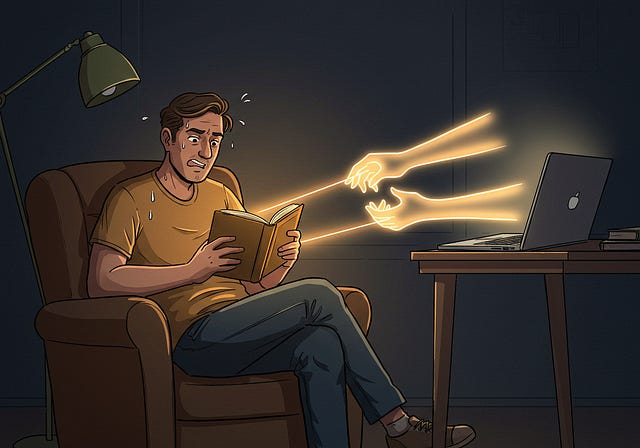
By Nikesh LagunAttention isn’t fragile. It’s a tug-of-war between what holds you in and what pulls you out.
By Nikesh LagunAttention isn’t fragile. It’s a tug-of-war between what holds you in and what pulls you out.
Hey friends,
Most people think focus breaks because we’re lazy, weak-willed, or easily distracted. But here’s the thing: focus doesn’t just snap out of nowhere. It’s not random. It’s not moral weakness.
Focus is the outcome of a hidden tension game between two opposing forces in your mind. Once you learn to see it this way, you stop blaming yourself and start playing smarter.
Think of Anchory as the glue that keeps you tethered to what you’re doing. It’s the mental force that stabilizes your attention. Anchory shows up when you’re engrossed in a movie and don’t notice time passing, when you’re mid-conversation and don’t hear your name, or when you’re locked in writing, coding, or gaming. Strong Anchory feels like flow. It doesn’t require effort to stay; it just holds. It’s built from immersion, relevance, and rhythm. The more of these you have, the stronger your Anchory.
Grain is the other side of the tug-of-war. It’s friction. It’s the mental resistance that builds until it pulls you away. Grain makes you wander to your phone, the fridge, or a random Google search. It shows up as clunky steps, discomfort, fatigue, stress, or interruptions from unfinished to-dos. Sometimes it builds slowly, sometimes it snaps like a trapdoor.
Focus breaks when Grain outweighs Anchory. Not because you’re weak. Not because you’re “bad at focusing.” Just because the tension tips. Imagine working on a report. Anchory is there, the deadline matters, and the timer is set. But Grain creeps in: a stiff neck, formatting glitches, inbox pings. Eventually, Grain wins, and you’re scrolling TikTok before you realize it.
If Anchory is the glue, how do you make it stickier? Shrink the scope: instead of “write the report,” go with “draft the first two sentences.” Use visible tethers like timers or sticky notes. Add rituals to cue your brain into work mode. Raise the stakes with reminders of why the task matters.
And how do you lower Grain? Remove friction by staging tools before you start. Take care of your body: stretch, hydrate, and eat. Capture open loops so they stop gnawing at your attention. Adjust the difficulty so the task feels challenging but doable.
In real life, you see Anchory and Grain everywhere. Gaming late into the night? Anchory is maxed, engagement, rhythm, relevance, while Grain is delayed until fatigue forces you out. Studying for an exam? Anchory is real, but Grain is overwhelming: dense material, stress, discomfort. Unless you trim the Grain, Anchory can’t hold. Scrolling social media? Anchory is artificially engineered, Grain is minimized, and you’re hooked.
When you understand focus as a tension game, you stop asking “Why am I so bad at focusing?” and start asking “Which side is winning right now, Anchory or Grain?” That single question changes everything. It replaces shame with strategy.
You can use a quick three-step check whenever focus wobbles. Name the pull: what’s the Grain right now: fatigue, friction, an open loop? Name the tether: what Anchory is holding you: a deadline, a timer, curiosity? Tip the balance: either strengthen Anchory (shrink scope, add ritual) or reduce Grain (cut friction, clear loops). Often, this saves your focus session without starting over.
Focus doesn’t break randomly. It breaks when Grain wins. Your attention isn’t fragile; it’s a tug-of-war you can learn to read and influence.
Next time you drift, don’t spiral into guilt. Just ask: what’s pulling me out, and what’s holding me in? Then tip the balance and get back in the game.
Wishing you a lighter, easier week ahead,
Nikesh Lagun
🎥 Video: Amishi Jha studies how we pay attention: the process by which our brain decides what’s important out of the constant stream of information it receives.
Author and researcher. I write about why starting and staying focused are hard, and how to make them easier.
One research-backed idea a month, straight to your inbox.
Originally sent in the Lagunian Dispatch newsletter. View the original on Substack.