Life & ideas
31 August 2025 · 4 min read By Nikesh Lagun
31 August 2025 · 4 min read
The noise inside your drive engine.
By Nikesh LagunSlip is the turbulence in your system, not laziness. Here’s how to track it and stay steady.
By Nikesh LagunSlip is the turbulence in your system, not laziness. Here’s how to track it and stay steady.
Hey friends,
One of the hardest parts of putting effort into anything isn’t outright failure. It’s the inconsistency. One day you’re steady and clear, and the next you’re scattered and restless. From the outside, it looks like you’ve lost discipline. From the inside, it feels like you’ve fallen off track.
But you didn’t fall off. Your system drifted.
In the field of Cognitive Drive Architecture (CDA), that drift has a name: Slip. CDA is a proposed field in cognitive psychology that studies effort not as willpower or motivation, but as a structural system that can be mapped and explained. Where traditional psychology talks about traits and tendencies, CDA treats the drive the way engineers treat engines: as something with switches, voltages, stabilizers, and noise.
At the heart of this framework is Lagunian Dynamics, the engine that defines six variables: Primode, your ignition switch; CAP, the voltage that powers you up; Flexion, the fit between you and the task; Anchory, the tether that holds you steady; Grain, the friction that slows you down; and Slip, the wobble in the system.
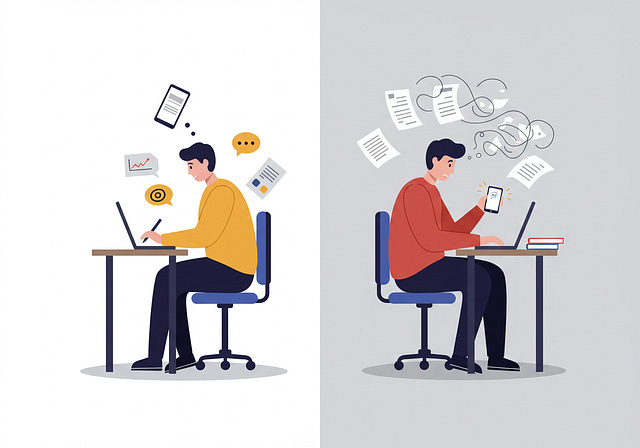
Slip is the one people mistake most often for weakness. It’s the drift in your focus and the random turbulence in mood and attention that makes your line of effort uneven. One day, you’re sharp. The next day, you’re foggy. Nothing major changed, but your rhythm won’t hold. That’s Slip.
In ADHD studies, Slip shows up as unstable effort patterns. In everyday life, it feels like an inconsistency. But it isn’t laziness or lack of discipline. It’s noise. Every system produces noise. Every engine vibrates when it runs. So does your mind.
The problem is that productivity culture has taught us to expect a clean, straight line of discipline. So when Slip shows up, we read it as failure. But it isn’t failure. It’s a built-in part of the system. It isn’t something to be ashamed of. It’s something to notice, track, and work with.
Pilots know planes drift. They don’t panic—they measure the drift and correct course. You can do the same. Once you log your Slip, it becomes data instead of self-judgment. Maybe it shows up after long monotony, late at night, or after skipping recovery. The patterns are there if you watch.
And while you can’t erase Slip, you can keep it within range. Quick daily notes on mood and focus. Anchors, such as timers, playlists, or quiet spaces, help hold attention steady. Shorter bursts of work instead of forcing marathons. Small injections of novelty to refresh the system. Recovery habits (sleep, exercise, and downtime) that shrink Slip’s amplitude. None of these are hacks. They’re stabilizers. They keep drift manageable.
Consistency doesn’t mean eliminating Slip. It means learning to operate inside it. When you see Slip as turbulence rather than collapse, shame eases. You adapt. And paradoxically, you become more consistent.
Slip is only one piece of the larger architecture. CDA also explores how ignition works, when action actually starts, and how unresolved tasks in the background create drag and interference. Together, these models make CDA not just another motivational theory but a field in cognitive psychology devoted to the structure of effort itself.
You didn’t fall off. You drifted. That drift is Slip. It isn’t proof you’re broken. It’s a sign you’re human. The real test isn’t avoiding drift. It’s recognizing it, tracking it, and correcting for it. Once you do, Slip stops being a source of shame and starts being a source of insight.
Wishing you a lighter, easier week ahead,
Nikesh Lagun
Based on four core works:
Switch On: A User’s Guide to Your Mind’s Drive Engine (Amazon, 2025)
🎥 Video: Crash Course explores how our own minds, our thoughts, attention, and memory can both support and betray us. That internal unpredictability you feel? It's not because you’re failing; it’s because your cognitive system carries noise by design.
Author and researcher. I write about why starting and staying focused are hard, and how to make them easier.
One research-backed idea a month, straight to your inbox.
Originally sent in the Lagunian Dispatch newsletter. View the original on Substack.