Stress & energy
23 November 2025 · 5 min read By Nikesh Lagun
23 November 2025 · 5 min read
The Hidden Reason You Collapse Under Stress While Others Don’t
By Nikesh LagunIt’s not confidence. It’s not courage. It’s architecture.
By Nikesh LagunIt’s not confidence. It’s not courage. It’s architecture.

Hey friends,
You know that moment when everything suddenly feels like too much?
A deadline hits. Eyes turn toward you. Stakes rise.
And even though you know what to do, your hands freeze, your mind blanks, and the task that felt manageable a minute ago becomes impossible.
Most people interpret that moment as failure, fragility, or lack of discipline.
But choking under pressure has nothing to do with weakness.
What’s actually happening is structural: your CAP spikes, and your system cannot hold it.
In Cognitive Drive Architecture (CDA), the field that models how effort actually ignites, sustains, and collapses, this moment is predictable. Lagun’s Law makes it clear: Drive is a structural output, not a moral quality.
When pressure rises, CAP, your Cognitive Activation Potential, the voltage of your system, surges. If the rest of your architecture is not strong enough to handle the load, the whole system buckles.
We are told to care more, push harder, and get motivated.
But Drive does not collapse because you do not care.
It collapses because your frame was not built for that level of load.
This is the core message of Lagun’s Law:
Train the structure, not just the moment.
Some people can take on intensity without losing stability. Others crumble at the slightest spike.
It is not personality. It is not courage.
It is a configuration.
CDA shows that every mind has a Drive Engine composed of six interacting variables: Primode, CAP, Flexion, Anchory, Grain, and Slip. These six determine whether you can begin a task, stay focused, resist overload, and recover after disruption.
Pressure does not introduce new weaknesses. It reveals structural limits.
Someone with strong Anchory, or attentional stability, can handle CAP surges without drifting.
Someone with high Grain, or internal friction, will lock up as soon as the stakes rise.
Someone with high Slip, or variability, will perform brilliantly one moment and crash the next.
The moment of choking is simply the moment your CAP exceeds what your Anchory, Flexion, and Grain can support.
Not a character flaw.
Not a motivational failure.
Just a structural mismatch.
Here is how the system actually works under Lagun’s Law, simplified in a single table:
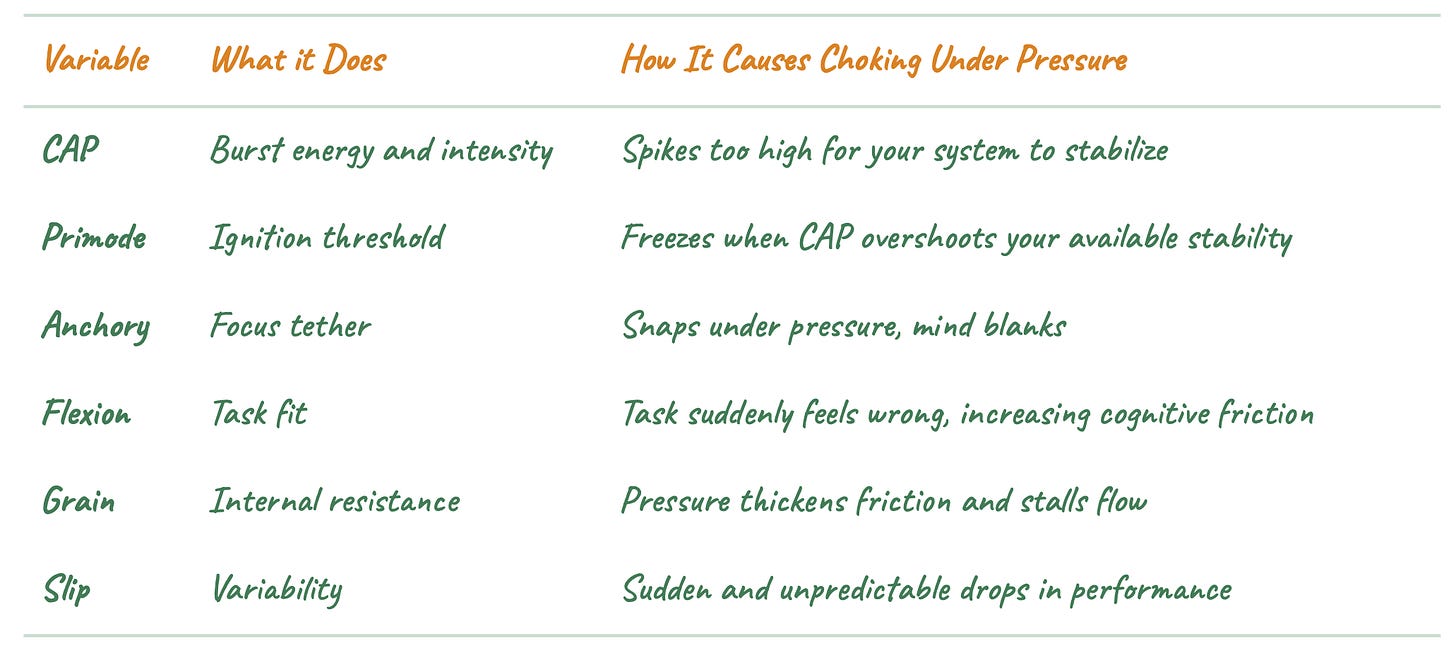
This explains why the same person can perform flawlessly in practice and fall apart in performance settings.
It is not an inconsistency. It is architecture reacting to load.
When people choke, the standard advice is:
Practice more.
Get used to pressure.
Build mental toughness.
But pressure failures do not happen because you lack skill.
They happen because your system’s structural tolerances are misaligned.
CDA research shows:
High performers do not have higher motivation. They have stronger Anchory and lower Grain.
ADHD patterns show the opposite: high CAP bursts but weaker anchoring stability and higher friction, producing collapse after intensity spikes.
Latent tasks amplify Grain and destabilize Anchory, making pressure collapses more likely even in capable people.
Pressure is a multiplier.
If your structure is shaky, pressure multiplies the instability.
Think about it:
You can do the work when it does not matter.
You can perform when no one is watching.
You can start when the environment is light.
But the moment stakes rise:
CAP skyrockets
Flexion shifts
Grain thickens
Anchory destabilizes
Your system gets hit by more force than it is built to handle.
It is the cognitive equivalent of putting 500 volts through a 200-volt frame.
You do not need more bravery.
You need a stronger frame.
Here is where Lagun’s Law becomes practical.
If choking is structural, then training must be structural.
Work in 10 to 15-minute cycles
Keep a simple return point you always come back to
Clear background latent tasks before doing high-stakes work
Anchory is what keeps you from spiraling when CAP rises.
Clear one small overdue task
Lower emotional stakes by reframing consequences
Remove friction points such as clutter or unclear instructions
Grain reduction is one of the fastest ways to prevent collapse.
Pressure amplifies mismatch.
A task that fits poorly will break under load.
Try:
Changing medium: writing, sketching, talking
Starting with a warm-up version of the task
Decomposing the task into simple mechanical steps
Flexion is how you reduce overload once the stakes rise.
Slip is variability.
Pressure amplifies turbulence.
Stabilize it by:
Keeping your environment predictable
Avoiding stacked stressful tasks
Using short pre-performance routines to reset state
Slip does not disappear, but it can be softened.
You want CAP at a usable level, not its maximum.
Try:
Slow breathing right before working
A 60-second orientation practice
Removing strong social evaluation cues
You do not suppress CAP. You modulate it.
Lagun’s Law reframes pressure collapse as structural failure, not moral failure:

When CAP spikes under pressure:
If Anchory is low, attention collapses
If Grain is high, friction blocks execution
If Flexion mismatches, the task stops fitting
If Slip surges, performance becomes erratic
You are not weak.
Your system hit conditions it was not built for.
The solution is not to be stronger.
It is to tune the architecture.
Pressure does not destroy a well-built frame.
It reveals it.
Imagine building a bridge.
You do not test it with maximum load before reinforcing the beams.
Your Drive Engine works the same way.
If you want to stop choking under pressure, do not wait for pressure to train you.
Train the stabilizers.
Reduce friction.
Improve task fit.
Learn to regulate internal voltage.
Then pressure becomes just another input, not a threat.
Once your structure is solid, the spikes do not scare you.
They strengthen you.
And you finally stop collapsing under moments that used to overwhelm you.
Wishing you a lighter, easier week ahead,
Nikesh Lagun
🎥 Video: Psy vs. Psy explains that when the stakes get high, even skilled people often choke because excessive pressure overloads their mental systems, causing working memory and automatic processes to fail.
Author and researcher. I write about why starting and staying focused are hard, and how to make them easier.
One research-backed idea a month, straight to your inbox.
Originally sent in the Lagunian Dispatch newsletter. View the original on Substack.