Hey friends,
Before we start this week’s issue, Got 5 seconds??
I’ll be sending another short email this Friday. It’s my first time sending two in one week. Hope that’s okay with you! 😁

It’s a little surprise, hehehaha. 🤪
Let’s start this week’s issue,
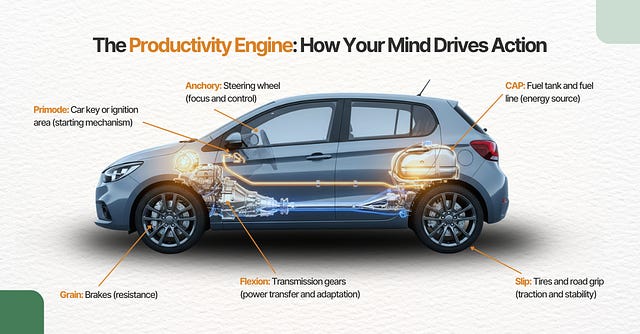
Think of your mind as a car. You have power under the hood, a full tank of fuel, and a clear road ahead. But for many people, the engine won’t start, or it starts and stalls. You know where you want to go, yet something inside resists motion.
That “something” isn’t laziness or lack of willpower. It’s a structural misalignment inside what I call your Productivity Engine, the internal system that turns intention into motion. Understanding how this engine works is the foundation of Cognitive Drive Architecture (CDA), a new field within cognitive psychology that studies how cognitive effort is initiated, sustained, and disrupted.
CDA isn’t just a theory; it’s a new field. It doesn’t describe motivation or attention from the outside. Instead, it defines the internal architecture that makes the effort possible in the first place. Traditional models like motivation theory, executive function, or attention control describe what effort looks like once it begins. CDA explains how the mind structurally configures itself so that effort can begin at all.
Inside CDA sits its core theory: Lagunian Dynamics.
Lagunian Dynamics defines six internal variables that govern whether Drive ignites, sustains, or collapses.
Primode: ignition readiness (your mental “start key”)
CAP (Cognitive Activation Potential): motivational voltage or energy source
Flexion: task–mind adaptability (your mental gears)
Anchory: attentional tether (your steering wheel)
Grain: internal resistance or friction (your brakes)
Slip: variability and instability (your tires’ traction)
Together, these variables form the mechanical structure of effort. When aligned, you act smoothly. When misaligned, you stall.
At the mathematical core of Lagunian Dynamics lies Lagun’s Law, the engine that drives the entire system.
Lagun’s Law:
This law models Drive not as motivation or emotion, but as a structural output, an emergent property of system alignment.
To make this concrete, imagine your mind as a car:
Primode → Ignition key: Can you start?
CAP → Fuel tank: Do you have energy to move?
Flexion → Transmission: Can you adapt gears to the terrain?
Anchory → Steering wheel: Can you stay on course?
Grain → Brakes: What’s slowing you down internally?
Slip → Tires: How much traction do you have?
Productivity problems occur when one or more of these parts misfire. You might have fuel (motivation) but no ignition (Primode). Or you start fast (high CAP) but lose control (weak Anchory). Understanding which part is misaligned lets you tune your cognitive engine rather than blaming yourself.
CDA isn’t limited to Lagunian Dynamics; it has specialized extensions that explore Drive across different dimensions. Cognitive Thermostat Theory (CTT) is a vertical expansion that focuses on when Drive activates. It models ignition as a control-theoretic feedback loop regulating mental energy in real time. CTT explains ignition failure, burnout, and recovery.
Latent Task Architecture (LTA) is a horizontal expansion that explores how tasks resonate with your Drive system. It studies how unfinished or poorly aligned tasks drain attention and increase resistance (Grain). LTA shows how external task structure interacts with internal cognitive architecture.
Together, CTT and LTA complete the field: CTT governs the timing of Drive; LTA governs the structural fit that sustains it.
When you feel stuck, you’re not lazy; you’re structurally misaligned. Here’s how to tune your variables:
This isn’t self-help; it’s system maintenance. Every adjustment restores alignment inside your Drive architecture.
Cognitive Drive Architecture redefines effort as a mechanical property of the mind, a system that can be understood, measured, and optimized. Lagunian Dynamics gives this system structure. Lagun’s Law gives it motion.
When you treat productivity as engineering instead of morality, you stop judging yourself for being “unmotivated” and start learning how to configure Drive. The goal isn’t to force action; it’s to align the engine.
That’s how you switch on your Productivity Engine.
Wishing you a lighter, easier week ahead,
Nikesh Lagun
✨ My Top Pick for This Week
🎥 Video: TED-Ed explores what happens in the brain to trigger procrastination, and what strategies you can use to break the cycle of this harmful practice.
 By Nikesh Lagun