Hey friends,
Your struggle with effort is not a personality flaw. It is a structural reality of how your Drive Engine works.
Some people seem naturally disciplined. They start quickly, stay focused, and rarely stall. You try to push yourself the same way, and sometimes it works for a day or two, but eventually you crash back into the same resistance.
Then you blame yourself.
But the truth is simple: effort is not discipline.
Effort is alignment.
When your internal configuration supports the task, movement feels easy. When the configuration is misaligned, even basic actions feel impossibly heavy.
Effort is not a moral quality. It is a structural one.
Why Effort Is Not About Willpower
You do not act just because you want to.
You act when your internal drive system reaches ignition.
You can feel motivated, interested, and even excited about a task, yet still remain completely still. Most people assume this means they lack discipline, but it actually means something much simpler.
Your ignition did not fire.
Your drive system did not cross the threshold required for movement. And when ignition fails, no amount of self-talk or pressure will magically convert desire into action.
What looks like discipline in others is usually the absence of internal friction.
Their system starts easily. Yours may not.
The Six Variables Behind Effort
Effort is created by six interacting variables inside your Drive Engine. These variables shape everything: how you start, how long you sustain, when you collapse, and why you feel stuck.
Here is the structure in plain language:
1. Primode
Your ignition switch. If this is blocked, you cannot start even if you care.
2. CAP
Your mental voltage. This is the energy surge that pushes intention into motion.
3. Flexion
The fit between your mind and the task. Good fit feels smooth. Poor fit feels heavy.
4. Anchory
Your attention tether. It determines how long you stay locked into a task.
5. Grain
Your internal friction. This is the emotional weight, dread, and resistance that slows you down.
6. Slip
Your variability. This is the unpredictability of your energy and focus.
These variables operate underneath your conscious control. They are not moral qualities. They are structural forces.
Your effort rises or collapses because these variables shift, not because your character changes.
What “Discipline” Really Looks Like
When someone appears disciplined, here is what is actually happening inside their system:
From the outside, it looks like they have strong discipline.
From the inside, alignment does the work for them.
You are not watching willpower. You are watching physics.
Why Effort Sometimes Feels Impossible
When your variables misalign, everything becomes harder:
You are not lazy. You are fighting architecture.
No amount of self-blame changes a system that is structurally misconfigured for the task in front of you.
A Quick Look at Structural Effort Patterns
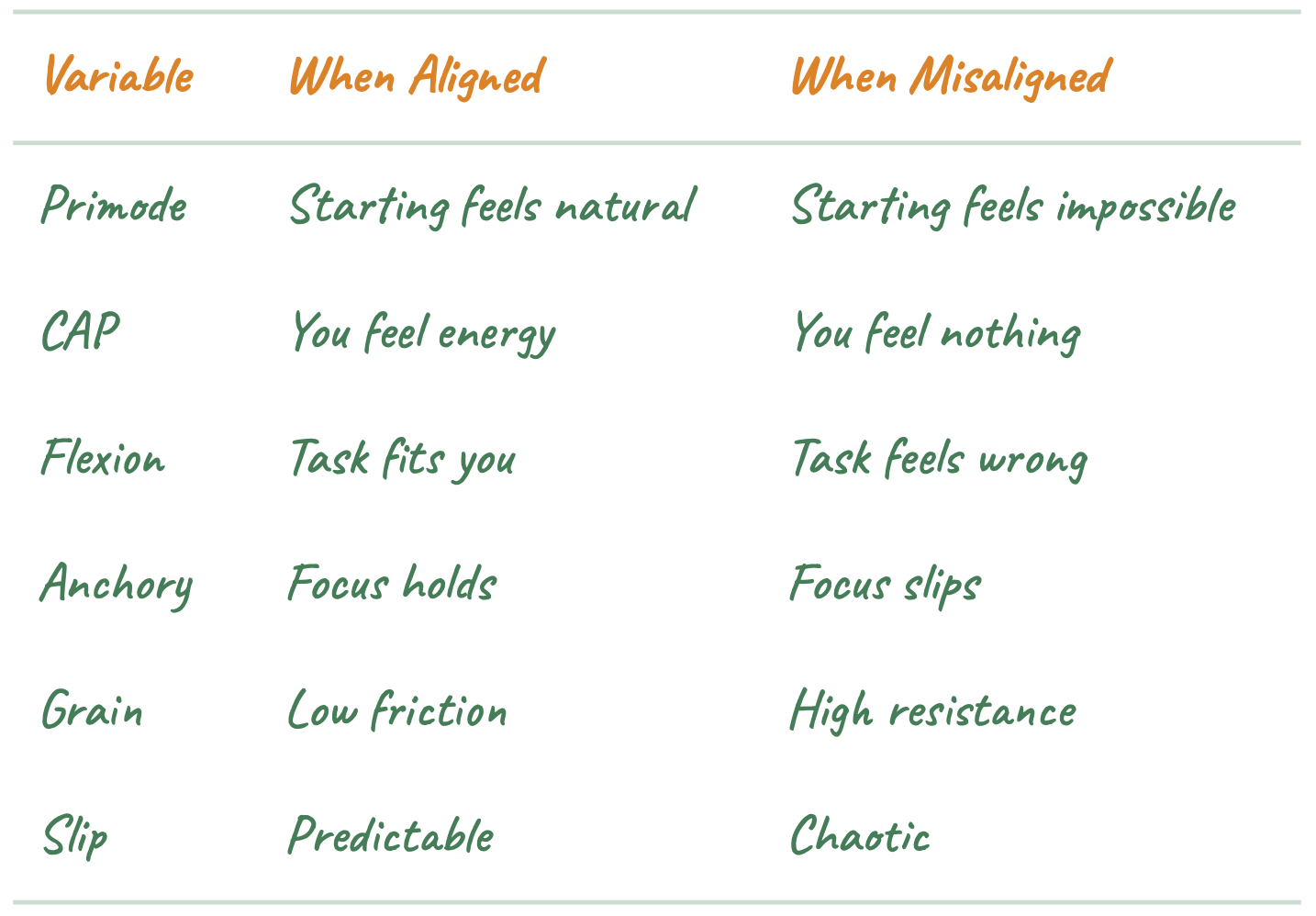
Here is a simple snapshot of how alignment changes the way effort feels:
This has nothing to do with discipline.
It is simply how your system behaves under different conditions.
The Silent Force That Blocks Effort: Latent Load
Sometimes your Drive Engine fails not because of the task you are trying to do, but because of the tasks you are not doing.
This is called latent load.
Latent load is the weight of unfinished tasks that quietly drain your cognitive bandwidth. You may not consciously think about them, yet they increase friction, weaken attention, and reduce the energy available for the task in front of you.
This is why your mind feels crowded even when your calendar looks empty.
You are not overwhelmed by the active task.
You are overwhelmed by everything surrounding it.
Two Simple Experiments to Understand Your System
These tests help you see your Drive Engine in action.
1. 90-second Ignition Test
What it reveals: Primode, CAP, and Grain.
How to do it:
Patterns:
Immediate movement → low Primode
Slow movement → moderate Primode
No movement → high Primode or high Grain
If starting is the hardest part, your ignition, not your motivation, is the issue.
2. Latent Load Release Test
What it reveals: Grain, Anchory, and CAP.
How to do it:
Patterns:
You feel lighter → Grain drop
You focus better → Anchory release
You feel motivated → CAP lift
Clearing even one small task can restore the drive you thought you lost.
How to Realign Your System
You do not need discipline. You need a configuration.
Use the structure below to realign each drive variable.
1. Improve Primode so that starting becomes possible
Lower the entry cost with tiny micro-start actions
Create predictable cues that signal the brain to begin
Define the next physical step instead of vague plans
Primode alignment makes ignition predictable instead of painful.
2. Boost CAP when motivation feels inconsistent
Use short, high-energy bursts instead of long sessions
Capture momentum quickly when activation surges appear
Begin during naturally high-energy moments in your day
CAP rises when you stop forcing endurance and start using voltage.
3. Fix Flexion when the task does not feel like it fits
Break the task into smaller, mechanical or low-resistance steps
Change environments to match the cognitive state you are in
Switch modalities such as outlining, sketching, or speaking
Flexion improves when the task matches your current mind, not the ideal one.
4. Strengthen Anchory when you drift easily
Work in 10 to 15 minute cycles for steady attention
Keep a simple return point that tells you where to continue
Clear background latent tasks before doing high-stakes work
Anchory is what prevents spiraling when CAP rises.
5. Reduce Grain before pressure hits
Clear one small overdue task to lower friction
Reframe consequences to soften emotional pressure
Remove friction points like clutter or unclear instructions
Grain reduction is one of the fastest ways to prevent collapse.
6. Manage Slip when your performance swings
Plan flexible pacing instead of rigid scheduling
Reserve difficult tasks for your more stable days
Avoid harsh self-judgment during unpredictable dips
Slip becomes manageable when you expect variability instead of fighting it.
Build Alignment Instead of Forcing Discipline
Your brain is not broken. Your system is not defective.
Effort does not come from willpower.
Effort comes from alignment.
Once you stop fighting your architecture and start designing around it, you discover something that feels almost like magic:
Your work flows.
Your focus holds.
Your starting gets easier.
Your energy stabilizes.
Your mind stops resisting.
This is what real effort feels like when the Drive Engine is finally configured to fit you.
Wishing you a lighter, easier week ahead,
Nikesh Lagun
✨ My Top Pick for This Week
🎥 Video: Thrive Foundry explains that procrastination happens not because of laziness, but because your brain experiences internal resistance and emotional friction that blocks the ability to start.
 By Nikesh Lagun